Planning journal
A T-Shirt Printing Booth for Corporate Family Days
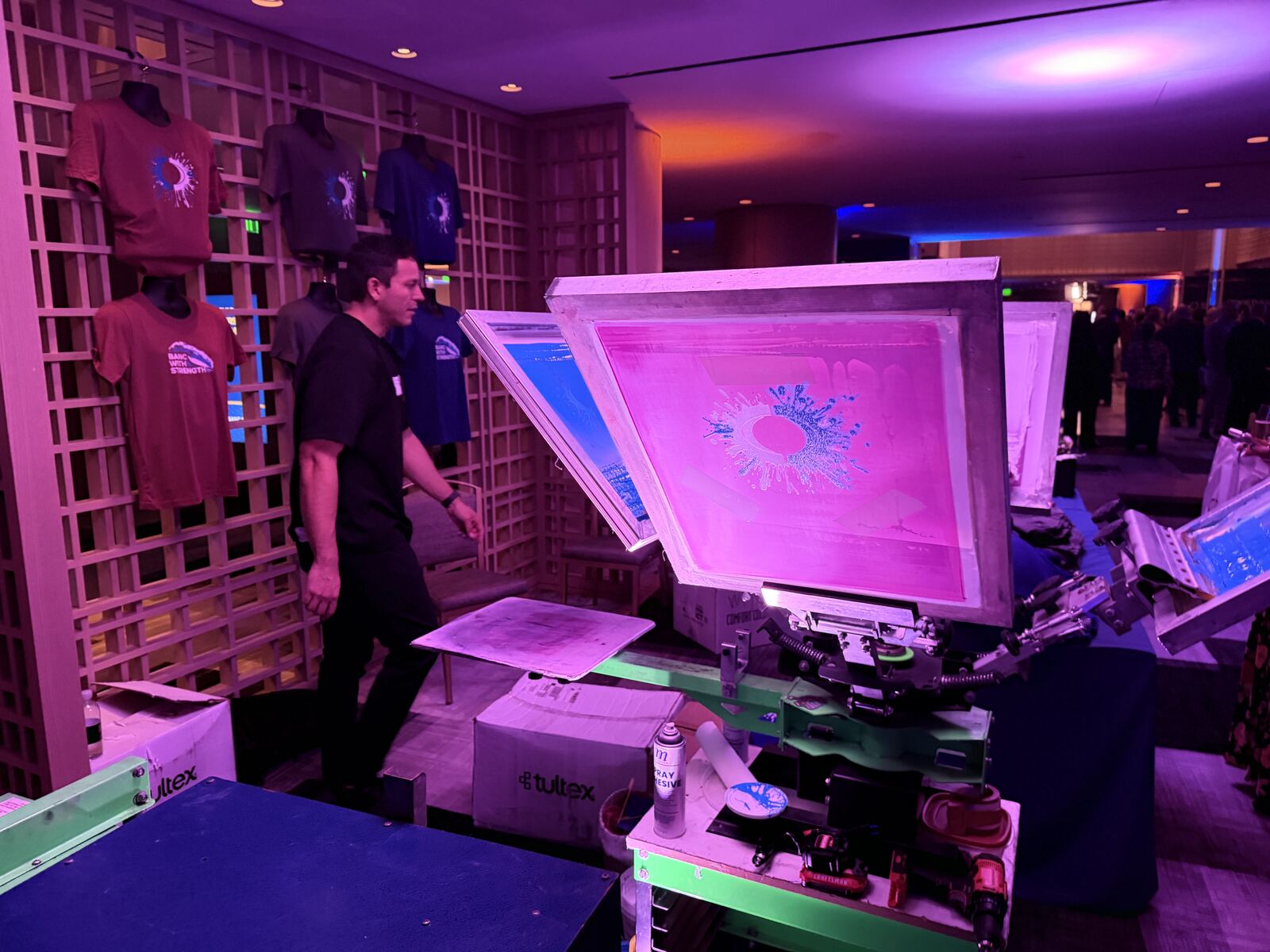
A t-shirt printing booth for corporate family days solves a problem the rest of the agenda does not: the four-year-old who has already been on the bounce house twice, and the employee’s partner who does not know anyone. A press running in the middle of a lawn gives both of them somewhere to go.
It is also the format where planners most often get the numbers wrong. Family days are not corporate events with extra people; the count, the size curve, and the safety picture are all different.
The counting problem nobody solves cleanly
Employee RSVP counts are reliable. Family counts are not. People forget to add a plus-one, then bring three kids and a grandmother. Others RSVP for four and arrive alone.
If you ran the event last year, last year’s actual attendance is worth more than this year’s RSVP form. If you have not, ask the RSVP form for a household count rather than a yes or no, and treat the total as a floor. Order roughly 1.05 to 1.15 pieces per expected attendee, and on a family day sit at the upper end of that band. Running out is the failure mode people remember, and blanks that go unused are not wasted — they become the next new-hire welcome kit.
Also count the people who are not on the list: the catering crew, the volunteer parents running the games, and the executives who show up for forty minutes. They all want a shirt.
The size curve is the whole game
This is where family day booths fail. A standard adult run of small through 2XL, ordered by someone thinking about a normal company event, leaves half the crowd unserved by noon.
Carry a broad, shallow youth run rather than a deep one. Youth extra small through youth large, plus toddler sizes if you expect little ones, and expect youth medium and large to clear first. On the adult side, family days skew larger than an office event because you are serving whole households, so do not trim the 2XL and 3XL to save money.
One practical trick: do not put every size on the visible rack. Keep the deep stock in cases behind the booth and display one of each. It stops the pile from being picked over and lets the operator control allocation as inventory tightens. Our post on booth throughput and guest count covers the arithmetic side.
What actually gets worn again
Family days are the one corporate event where the merch has a real second life, because kids wear the shirt to school. That should shape the design.
- Keep the logo modest. A giant corporate mark on a seven-year-old is a company uniform. A mascot, an illustration, or the year reads as a souvenir.
- Offer a personalization field. First name on the front or back is the single highest-value option you can add, and it costs almost nothing.
- Build for the family photo. One shared graphic across all sizes means the whole household matches, which is the picture that ends up on the company intranet.
- Two or three designs, not eight. Choice paralysis at the order point is a real throughput cost when the person deciding is six.
Hot equipment and small people
A heat press runs hot enough to matter, and a family day is the one context where that needs a deliberate plan rather than assumed adult caution.
Set the press deeper in the footprint than you would at a corporate mixer, so there is a table line or a barrier between the queue and the equipment. Never position a platen at child height on an open side. Keep power cords run behind the booth and taped or covered, because a lawn full of running children finds every cable. And staff enough people that an operator is never alone with the press while also handling a queue.
None of that slows the line down noticeably. It is layout discipline, not extra process. Ask any vendor how they handle it, and if the answer is a shrug, keep looking.
Beat the gate rush
Family day traffic arrives in one lump. Gates open, everyone walks in together, and every activity gets hit at once.
Two ways to flatten it. Pre-press a base run of the most popular design across the youth and core adult sizes so the first thirty minutes can be grab-and-go while the custom lane starts. And use claim tags from the beginning, so families can go eat and come back rather than standing in a line with restless kids.
On capacity, a station finishes roughly 60 to 90 pieces per hour. A 400-person family day across three hours needs two stations, or one station plus a substantial pre-pressed run. Do that math before you book one press and hope. Our booth planning guide walks through the layout, and pricing shows how station count moves the number.
Frequently asked questions
How do we estimate shirt counts when employees bring their families?
Start with confirmed employee RSVPs and apply an average family size drawn from last year if you have it, because household size varies enormously between companies. Then add a real buffer, since family day headcounts are the least reliable numbers in corporate events. Ordering about 1.05 to 1.15 pieces per expected attendee is the baseline, and family days deserve the top of that range.
What youth sizes should we order for a corporate family day?
Carry youth extra small through youth large plus a toddler range if you expect young children, and expect youth medium and large to move fastest. Toddler sizes are lower volume but the ones parents are most disappointed to miss. A good rule is to keep the youth run broad and shallow rather than deep in two sizes.
Is a hot press safe with children around the booth?
Yes, with the same discipline any hot equipment needs at a public event. We set the press deeper in the booth than adults expect, keep a barrier or table line between the press and the queue, and never place the platen at child height where it can be reached. Our operators run the equipment, and guests never touch it.
Tell us your headcount and we will size it
Send the date, the venue, and your best guess at attendance including families, and we will come back with a station count, a size run, and a plan for the gate rush. Start a quote or call (562) 614-4800.